

Building a Real Recovery Routine for Irondequoit's Fall Athletes
Two-a-Days Are Over, but the Season Just Started
By the second week of September, the fall sports calendar in Monroe County is in full swing. Section V soccer, football, volleyball, cross country, tennis, and swimming are all running at once, and if you're a parent, your week now revolves around practice pickups and away games in Webster, Greece, and Penfield.
Here's the part that gets missed. Preseason gets all the attention — the conditioning, the physicals, the two-a-days in August heat. Then the season starts, and the assumption is that the hard part is behind you. In our experience at IronChiro, the injuries we see in student athletes cluster in weeks three through eight of the season, not in preseason. That's when accumulated fatigue, five or six days of practice a week, games on tired legs, and homework-fueled short nights all stack up.
Recovery is the variable almost nobody plans for. Kids plan practice. They plan lifting. Very few high schoolers have a recovery routine, and that's the gap worth closing.
What "Fatigue Injuries" Look Like in a Teenager
Adult athletes tend to report pain directly. Teenagers report it sideways. Some of the things we hear from parents that turn out to be early overuse issues:
"He's fine at practice but limps up the stairs the next morning."
"She says her shins are just sore. They've been just sore for a month."
"He stopped diving for balls in the second half."
"Her back hurts when she serves, but only after the third set."
"He says his hip is tight. He's been stretching it every day and it isn't loosening."
That last one matters. Something that feels tight and doesn't respond to stretching is often not a flexibility problem at all — it's a joint that isn't moving well, or a muscle guarding because something nearby isn't doing its job. Stretching harder in that scenario is usually wasted effort, and sometimes it makes things worse.
The other pattern specific to this age group: growth. Adolescent athletes are dealing with growth plates that are still open and bones that are lengthening faster than the muscles and tendons attached to them. That's why heel pain, knee pain at the front of the joint, and pain right at the bottom of the kneecap are so common in 11- to 16-year-olds. These are real, well-described conditions with real management strategies. They're also frequently dismissed as growing pains and left alone, which is how a two-week problem becomes a lost season.
A Recovery Routine That Fits a Real School Week
The best recovery plan is the one a 15-year-old will actually do. Ours is deliberately unimpressive.
Sleep is the whole ballgame. Eight to ten hours for a teenage athlete, and it's the single most protective factor against soft-tissue injury. A phone charging outside the bedroom does more for a hamstring than any gadget on the market.
Ten minutes of movement after practice, not before bed. Easy walking, breathing down, light mobility for the hips and ankles. It doesn't need a name or an app.
Fuel within an hour of finishing. Protein and carbohydrate together. A lot of the "dead legs by Thursday" complaints are simply a teenager who ate a granola bar at 11 a.m. and nothing since.
Water, in a bottle they carry. Fall practices feel cool, so kids drink less — but they're still sweating in pads and long sleeves.
One genuinely easy day per week. Not off, just easy. Bodies adapt during the easy days, not the hard ones.
A weekly check-in with an adult. "What hurts, how much, and is it getting better or worse than last week?" Written down, so drift gets caught early.
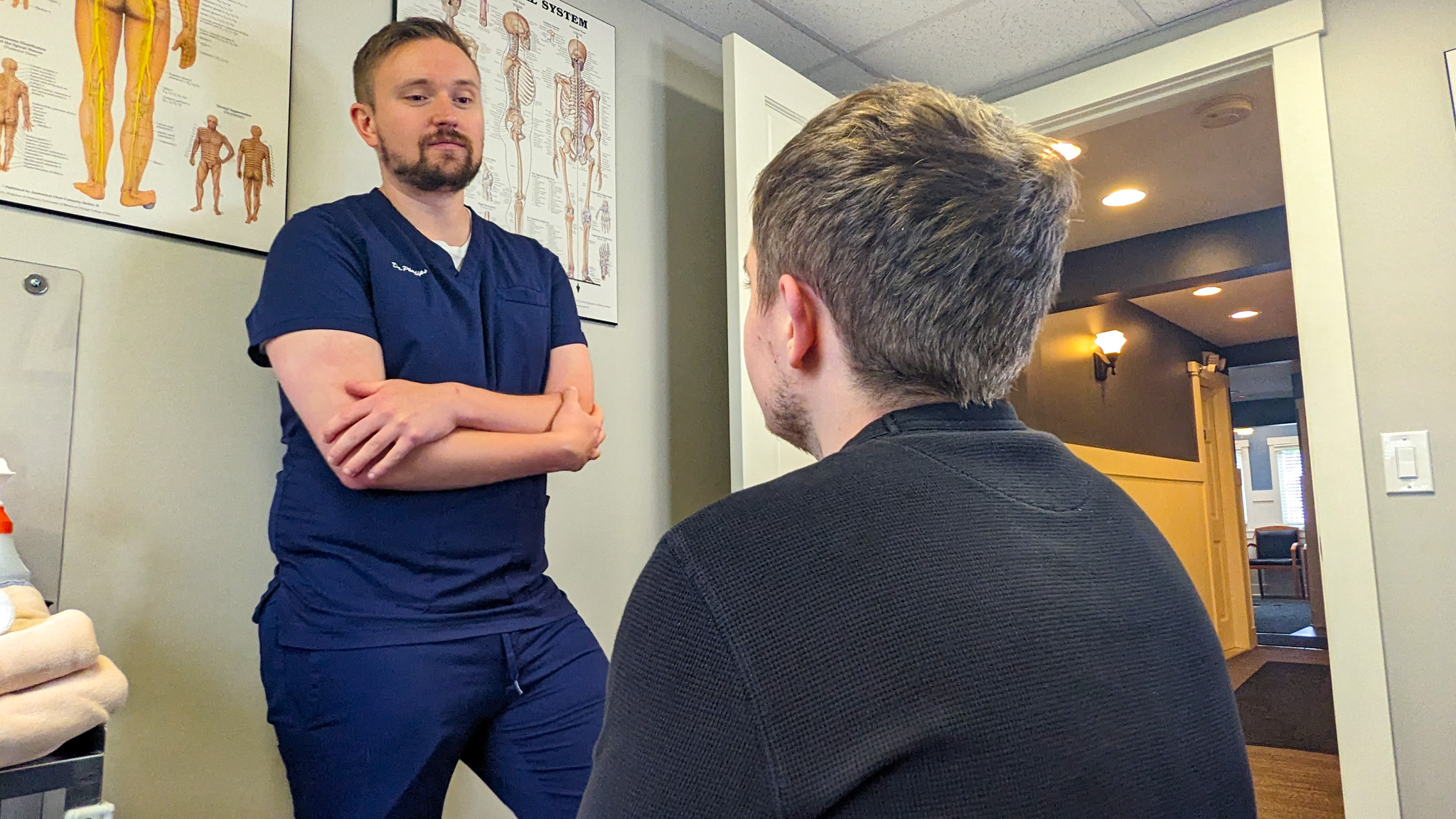
Where Chiropractic Care Comes In
Chiropractic care for an in-season athlete isn't about chasing pain. It's about keeping joints moving through their full range so the body isn't compensating.
A soccer player who has lost rotation in one hip will find that motion somewhere else — usually the low back. A volleyball player with a stiff mid-back will pull extra range out of the shoulder every time she hits. A cross country runner with restricted ankle motion loads the shin and knee differently with every stride. None of that hurts at first. It just quietly changes how force travels through the body, and after a few thousand repetitions, something complains.
When a student athlete comes to our Irondequoit office in season, an evaluation typically looks at how the spine, pelvis, hips, and ankles are moving, how well they control single-leg positions, whether left and right sides match, and where the actual restriction sits relative to where the pain is. Care from there is usually a combination of adjusting restricted joints, hands-on soft tissue work, and a short list of specific exercises — the emphasis on short, because a kid with practice six days a week will not do a twenty-minute program.
Timing matters too. In-season care is scheduled around the competition calendar, not dropped on top of it. We'd rather see an athlete the day after a game than the morning of one.
Where Massage Therapy Comes In
Massage therapy is the piece families most often overlook for teenagers, usually because it sounds like a luxury. Used well, it's practical maintenance.
It addresses the accumulated tissue tightness that comes from repeating one sport-specific pattern hundreds of times a week.
It gives us a way to work on the calves, hamstrings, hip flexors, and upper back without adding more load to an already-loaded athlete.
It helps with the nervous-system side of a long season. Sleep quality often improves in the days after a session, and for a teenager in the middle of a season plus a class schedule, that alone is valuable.
It's one of the few interventions an athlete looks forward to, which means compliance is not a problem.
For most in-season high school athletes, something in the range of every two to four weeks is realistic — more often around a heavy stretch of the schedule, less often when things quiet down. Our licensed massage therapists at IronChiro coordinate with the chiropractic side, so the hands-on work targets the same areas the exam flagged instead of being a generic full-body relaxation session.
When to Stop Waiting It Out
Some soreness is part of sport. These are the situations where waiting is the wrong call:
Pain that's present at rest or at night, not just during activity.
Pain that's changing how they move — a limp, a shortened stride, a serve or throw that looks different.
Swelling, or a joint that gives way, catches, or locks.
Any numbness, tingling, or weakness.
Pain located right on a bone rather than in the muscle.
Soreness that has been the same or worse for more than two weeks.
Any head injury. Concussion management belongs with a medical provider and the school's protocol, and return-to-play is not a decision to hurry.
The honest reason to come in early has nothing to do with drama. Early problems in teenagers respond fast. The same problem left for two months usually means missed games, which is the outcome everybody was trying to avoid in the first place.
What Parents Can Do This Week
Look at the shoes. Cleats and running shoes from last spring may have hundreds of miles on them. Worn-out footwear is one of the most common contributors we see in fall athletes.
Check the bag. A loaded gym bag carried on one shoulder every day is its own problem, especially on top of a school backpack.
Ask a better question than "how was practice?" Try "anything hurt today, and was it better or worse than yesterday?"
Protect one night a week. A season with zero true rest days is a season with a higher injury rate.
Don't wait for the season to end. In-season care is designed to keep athletes playing, not to sit them down.
Let's Keep Your Athlete in the Game
Fall sports in Irondequoit run hard from Labor Day through sectionals, and the athletes who make it to the end of that stretch healthy are usually not the toughest ones. They're the ones who recovered well and dealt with small problems while they were still small.
If your athlete is nursing something that isn't improving — or if you'd rather get ahead of it — IronChiro is at 2164 Hudson Avenue in Irondequoit, open Monday through Friday. Call 707-57-CHIRO (707-572-4476), email info@ironchiro.com, or use the contact form at ironchiro.com to schedule an evaluation. We'll tell you honestly what we're looking at, what care would involve, and whether they need to sit out at all.


Comments